
A brick wall can turn a driveway into a practice space fast. It can also turn a bad throw into a sharp, unpredictable ricochet with no margin for error. That is the real question in the baseball rebounder vs wall drills debate: not which option is tougher, but which one gives a player more useful, repeatable reps for the skill they are trying to build.
Wall drills still have a place. They are simple, available, and effective for certain throwing routines. But a purpose-built rebounder gives coaches and players more control over ball return, training angles, safety, and setup. The better choice depends on the player’s age, available space, training goal, and how often the equipment will be used.
Baseball Rebounder vs Wall Drills: The Core Difference
A wall is a fixed surface. Throw the ball into it, react to the return, and repeat. That simplicity is why wall work has been part of baseball and softball development for generations. Players can work on receiving, quick hands, throwing rhythm, and staying athletic without a partner.
The limitation is that the wall decides the rebound. A ball that hits a seam, an uneven area, a corner, or a rough brick can come back low, high, sideways, or not at all. That unpredictability can be useful when a player is advanced enough to react safely, but it can also turn a focused drill into a chase-the-ball session.
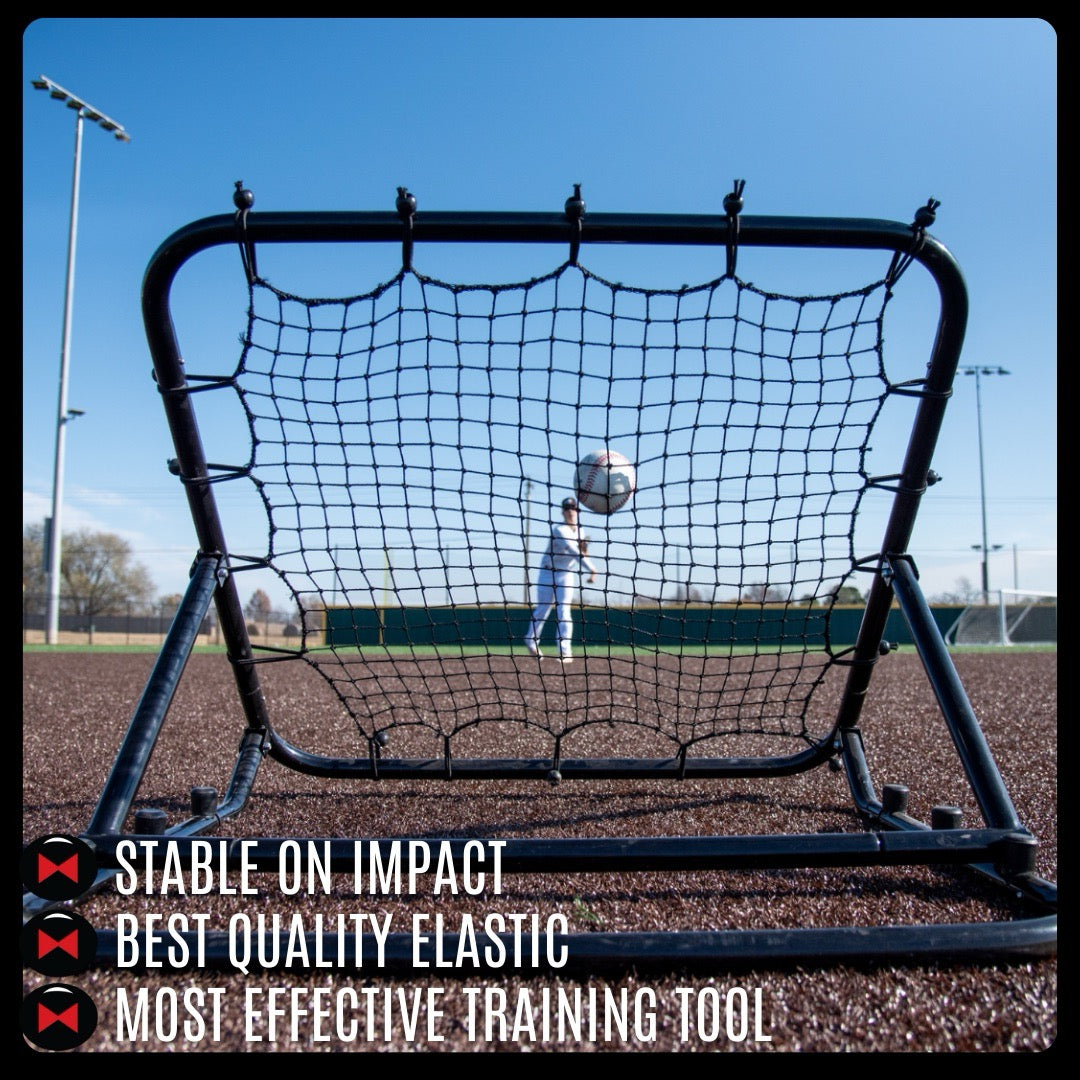
A baseball rebounder is built to return the ball through tensioned netting or a controlled rebound surface. The player can usually adjust the angle to create ground balls, short hops, chest-high returns, or more direct throwing feedback. Instead of hoping for a clean return, the athlete can set the type of rep they need.
That difference matters most when practice time is limited. A controlled return means more repetitions with a purpose and fewer interrupted reps retrieving balls from the yard, driveway, or gym.
Where Wall Drills Still Work
Wall drills are not obsolete. For basic catch play mechanics, a clean flat wall is hard to beat because it requires almost no setup. A player can stand close to the wall and work rapid exchanges, or back up and focus on a consistent throwing path. The wall also gives immediate feedback: an off-line throw often comes back off-line.
For infielders, short-distance wall work can help develop soft hands and a quick transfer. For pitchers, a wall can provide a simple target during dry throwing rhythm drills when there is no catcher available. For younger players, it can make independent practice feel accessible rather than complicated.
The trade-off is safety and consistency. Walls do not absorb energy. Hard-thrown baseballs and softballs can return quickly, especially when the player is too close or the surface is uneven. A missed catch near a window, vehicle, or another player creates a problem fast. Coaches also have less control over where a group is working, which is a real issue at busy practices.
Use a wall when the surface is clear, the space behind the player is open, and the goal is simple throwing or close-range hands work. It is a tool, not a complete training system.
Why a Rebounder Produces Better Skill-Specific Reps
A rebounder earns its space because it lets the player organize the drill around a specific outcome. Adjust the frame angle lower for ground-ball work. Raise it to train a more direct return. Move closer for quick hands and reaction training, or create distance to work throwing accuracy and catch position.
That control helps players avoid a common training mistake: repeating movement without knowing what they are training. If an infielder needs to improve their ability to read a short hop, the rebound should be set to create short hops. If an outfielder needs clean hand positioning and a strong throwing exchange, the return should support that sequence rather than send random ricochets.
Rebounders also create cleaner practice environments. A tensioned net absorbs part of the ball’s energy, reducing harsh returns and helping keep the ball in a predictable lane. That is especially valuable for youth players, travel teams, and facilities where multiple athletes train close together.
The benefit is not that every return is easy. Good rebounder work can still challenge reaction time, footwork, and hands. The difference is that the challenge is adjustable. A coach can increase difficulty with distance, angle, ball type, tempo, or movement before the throw. The equipment should support the drill, not create random risk.
Better Repetition for Infielders
Infielders need more than barehand reaction speed. They need to arrive on balance, present the glove early, control the hop, move through the ball when appropriate, and make a clean exchange. A rebounder can create repeatable ground-ball and short-hop patterns so the player can focus on those details.
Start with controlled forehand and backhand reps. Then add movement by beginning a few steps to either side of the rebounder. The player should work to field the return out front, gather their feet, and make a purposeful throw to a target. The goal is game-ready footwork, not just catching whatever comes back.
Better Repetition for Throwers
A wall can expose poor accuracy, but it does not give a player much help with target discipline. A rebounder gives the athlete a defined return area and a more consistent visual target. That makes it easier to train catch-to-throw rhythm, arm path, and receiving position.
For pitchers and position players, use a rebounder at a manageable distance and throw with intent rather than simply firing balls as hard as possible. A good throwing drill should reinforce balance, direction, and a clean finish. Volume only helps when the movement quality holds up.
Safety Is More Than Avoiding Broken Windows
When parents and coaches compare a rebounder with a wall, safety usually starts with property damage. That is fair, but it should not end there. The bigger question is whether the practice setup allows an athlete to train confidently without taking unnecessary bad hops to the face, chasing balls into unsafe areas, or throwing toward a crowded space.
A quality rebounder gives the coach a defined station. Players know where to stand, where the ball should return, and where other athletes should not be. That structure makes a difference during team practices, camps, and indoor work where space is tight.
Frame construction matters, too. Lightweight equipment may be convenient for occasional backyard sessions, but it can shift or tip if it is not designed for repeated impact. High-volume programs need equipment that stays planted, handles hard throws, and keeps its shape over time. A rebounder that loses tension or bends at the joints changes the drill and wastes the investment.
Choosing the Right Setup for Your Player or Program
The best choice is rarely just “wall” or “rebounder.” Many serious players use both. The wall is available for simple, low-cost throwing work. The rebounder becomes the dedicated station for repeatable fielding, reaction, and targeted throwing drills.
For a younger athlete training at home, portability may be the deciding factor. The Web Flex Sports Spider Series is the practical answer when a player needs a lighter, travel-friendly setup that can move from the backyard to the practice field without taking over the garage. It gives families a purpose-built training station instead of asking a player to make every wall, fence, or driveway work.
For high school programs, travel organizations, and private facilities, durability should carry more weight. The Web Flex Sports Pro Series is built for high-repetition use, with heavy-duty construction and patented shock-absorbing technology designed for serious training environments. That matters when a screen or rebound station sees daily throws from multiple athletes and needs to stay reliable season after season.
Do not buy more equipment than the training plan requires, but do not underbuild a station that will take constant use. A solo player who needs portable reps has different needs than a facility running stations for twelve infielders. The right rebounder matches the workload, available space, and level of supervision.
How to Make Rebounder Drills Carry Over to Games
A rebounder only improves performance if the player trains with intent. Random rapid-fire catches may build activity, but they do not automatically build better defense. Give each set a clear focus: fielding out front, staying low through the ball, gaining ground on a throw, using two hands on a routine catch, or improving the transfer after a backhand.
Keep early sets clean and controlled. Once the player owns the movement, add difficulty by changing the angle, starting position, or required footwork. For example, an infielder can begin two steps to the left of the rebounder, move through a simulated ground ball, and finish with a throw to a separate target. That turns a stationary return into a full defensive action.
Quality also matters more than endless volume. Twenty focused reps with proper posture and footwork are better than one hundred rushed touches with the glove drifting, feet stopped, and throws sprayed around the yard. Video can help players see what they miss at full speed, especially during solo sessions.
A wall will always be there when a player needs a few simple throws. But when the goal is safer work, cleaner feedback, and repeatable game-relevant reps, a well-built rebounder gives the athlete a better station to earn those improvements.