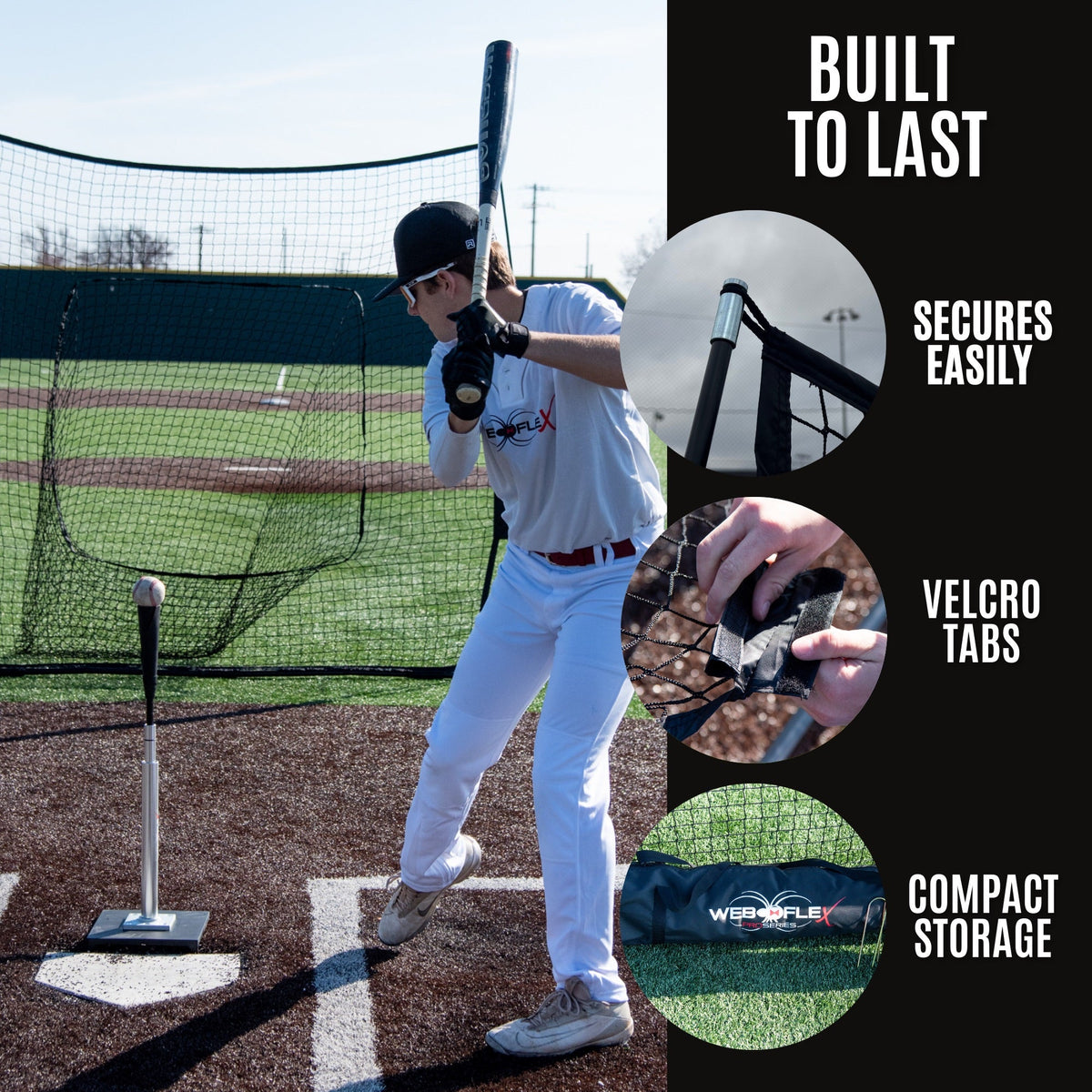

A coach standing 45 feet from live hitters has one job before the first pitch is thrown: stay protected without slowing practice down. A baseball l-screen is the piece of equipment that makes that possible. It gives the pitcher, coach, or front-toss thrower a protected window to deliver real reps while keeping hard-hit balls from ending a batting practice session early.
The right screen is not simply the biggest one available. It has to fit the speed of the hitters, the surface you train on, the number of daily reps, and whether the screen will live in one cage or travel every weekend. Get those details right, and an L-screen becomes one of the hardest-working tools in your program.
What a Baseball L-Screen Does
An L-screen is a protective field screen with an offset opening that allows a coach or pitcher to throw through the net while keeping their body behind the frame. The shape is what separates it from a standard square field screen. Rather than forcing the thrower to stand beside the protective area, the opening lets them work from a natural throwing position.
That matters in live BP, front toss, machine feeding, and pitching drills. Hitters see a more realistic release point. Coaches can keep the drill moving. Most importantly, the person feeding balls has a barrier between them and the hardest line drives in the cage.
For youth teams, an L-screen often protects a parent or coach who is throwing hundreds of pitches in a practice. For high school, college, and facility settings, it has to absorb repeated contact from stronger hitters without walking backward, folding, or wearing through at the impact area.
Start With the Demands of Your Practice
The best screen for a backyard hitter is not automatically the best choice for a travel organization or indoor facility. Before looking at frame size or net thickness, be honest about how the screen will be used.
A player taking occasional soft toss needs portability and quick setup. A team running daily cage work needs a frame that stays planted and netting that handles repeated ball impact. A coach throwing live BP to older hitters needs a generous protected area, because the danger zone extends beyond the strike zone and beyond the center of the net.
Think through four questions before buying:
- Who will be hitting into the screen, and how hard do they hit?
- How often will the screen be used during a normal week?
- Will it stay on one field, or be loaded in and out for practices and tournaments?
- Is the throwing surface grass, turf, concrete, or a batting cage floor?
Frame Strength Is the First Durability Test
The frame takes the force every time a ball finds the screen. Thin, weak tubing can bend at connection points, especially when a screen is hit repeatedly in the same area or dragged across rough ground. Once a frame loses its shape, the net may sag, the feet may sit unevenly, and the screen stops doing its job well.
Look for a rigid steel frame designed for practice use, not a light recreational net adapted into an L shape. Weld quality, tube diameter, stable feet, and reinforced connection points all affect how the screen performs over time. A well-built frame should feel settled when a hard ball hits the net, rather than twisting or scooting across the surface.
For programs putting in high-volume reps, the Web Flex Sports Pro Series is built for that workload. Its heavy-duty construction and patented shock-absorbing technology help manage repeated impact, while the lifetime frame warranty speaks directly to coaches and facilities that need equipment they can keep in rotation. This is the right direction when the screen will see daily batting practice, advanced hitters, or year-round cage work.
Netting Determines How Long Protection Lasts
A strong frame cannot compensate for netting that wears out too quickly. Netting is where baseballs make contact, and it needs to absorb energy without tearing, stretching excessively, or developing weak spots at the edges.
Thicker, higher-quality netting is generally the better choice for high-velocity training. Pay close attention to the impact zone around the throw-through opening and the lower half of the screen. Those areas tend to receive the most direct contact during BP and front toss. Border rope and secure net attachment also matter because a net can fail at its perimeter even if the mesh itself looks fine.
Netting will not last forever. Sun exposure, moisture, turf abrasion, and nonstop impact all take a toll. The practical goal is not to find a screen that never needs attention. It is to choose one engineered to hold its shape and protect the thrower through the volume of work you actually do.
If your screen stays outdoors, inspect it regularly. Look for fraying, stretched mesh, loose ties, and spots where the frame rubs the net. Small issues are easier to manage before a hard-hit ball turns them into a hole.
Size and Opening Placement Affect Safety
An L-screen should give the thrower enough coverage to move naturally. If the opening is too narrow or the protective panel is too small, a coach may lean outside the screen just to deliver a strike. That defeats the point.
A larger screen creates a more forgiving work area, particularly for coaches who throw from varying distances or for programs that rotate multiple throwers through a station. The trade-off is storage and transport. Bigger screens occupy more space in a garage, equipment room, trailer, or cage, so measure where the screen will live before committing to a larger footprint.
Opening placement also matters. Make sure the throw-through window matches the hand and throwing style of the person using it. The goal is a clear lane to the hitter with the head, torso, and legs protected behind the frame. Set it up before practice begins, then test the angle with a few dry throws. A screen positioned square to the hitter may not always be the safest position for the thrower.
Portable Does Not Have to Mean Flimsy
Travel ball families and coaches often need a screen that can move from a driveway to a practice field to a tournament weekend. That is where portability becomes a real performance feature. If equipment is difficult to carry, set up, or fit in a vehicle, it tends to stay home.
The Spider Series is the practical answer for athletes and teams that need a lighter, more travel-oriented setup without treating protection as an afterthought. It suits lower-volume use, mobile training, and budget-conscious buyers who still want dependable practice infrastructure. It is especially useful for front toss, tee work, youth training, and teams that need to build a workable station quickly.
The trade-off is straightforward: portable equipment is built around convenience, while a premium heavy-duty screen is built around maximum long-term abuse resistance. Neither is automatically better. A Spider Series screen makes sense when mobility drives the decision. A Pro Series screen makes sense when your environment demands the toughest setup available.
Set Up the Screen for the Drill, Not Just the Space
Even a well-built L-screen needs correct placement. Put it on stable, level ground whenever possible. On turf or grass, make sure the feet sit flat rather than rocking on uneven soil. In a cage, leave enough room behind the screen for the thrower to work without stepping into another training lane.
For front toss, position the screen so the thrower can release the ball through the opening while remaining fully protected after the release. For live BP, give the screen enough distance from home plate that the pitcher has room to finish the delivery safely. Never assume the net alone makes any position safe. A deflected ball can come off the frame, net, bat, or floor at an unexpected angle.
Use the screen as part of a complete practice setup. Keep buckets, balls, and spare bats out of the thrower's landing area. Establish a clear path for hitters entering and exiting the cage. If several stations are active, make sure one group is not firing balls into the back of another group's screen.
Make the Screen Earn Its Spot in Practice
A baseball L-screen earns its value through repetition. Use it for live BP, front toss, pitching command work, and any drill where a coach or player is exposed to batted balls. The safer the thrower feels, the more consistent the reps become. Consistent reps are what help hitters see quality pitches and help teams get more done in the same practice window.
Choose the screen that matches your hitters, your schedule, and your training environment. Then set it up correctly, inspect it often, and let your coaches throw with confidence instead of bracing for the next line drive.